Monday, April 11, 2011

Aguilar TONE HAMMER


I love Aguilar stuff.  I’ll be the first to admit it boarders on the unhealthy.  This is one of the few companies that I literally want EVERYTHING that they make.  Even if I obviously have no use for half of it at anyone time (doom rig anyone?).  There is something about their approach to bass gear that just grabs me.  Maybe it is the super clean lines, or their commitment to quality, but I love their stuff and I want to try it all.  The Tone Hammer was my first introduction to Aguilar’s product line, even though it is oddly enough a pedal, not the high end bass amplification that Aguilar is known for.


From Aguilar:
This preamp/direct box is so strong and powerful it could only be called the "Tone Hammer"! Based on the respected OBP-3 preamp, the Tone Hammer features fully sweepable midrange frequencies in addition to bass and treble controls. With the Tone Hammer's pristine D.I. you are set for the studio or the stage.

CONSTRUCTION:
This pedal is housed in a heavy duty steel enclosure that is near bullet proof.  The knobs are solid and the switching is true bypass.  Having said that, you must keep in mind that this was Aguilar’s first foray into the world of effects, and like all first steps, they aren’t always perfect.  Dave Boonshoft (president of Aguilar) caught some heavy flak from pedal heads for the design of this pedal. As you can see, in the photo below the enclosure of the pedal sticks out over the edge of the input and output jacks, seemingly in an effort to protect them (maybe?).  
The problem is that if the pedal is lying flat on a normal pedal board, you are only able to use straight 1/4” jacks or cables to plug in and out of the Tone Hammer, robbing you of valuable pedal board space if you don’t have a slotted pedal board like the pedaltrain pedal boards.  Once solution I have seen is to use a dremmel drill or similar minute grinding tool to cut away part of the steel enclosure to allow access to the input and output jacks by right-angled plugs.  
Another design quirk that comes along with this pedal is that the knob that holds the battery drawer (neat, BTW) in place is located on the bottom of the pedal, which makes mounting the Tone Hammer onto pedal boards without the (huge) rubber feet nigh on impossible.  Two solutions: either use a pedaltrain style board with slats or put a rubber pad on either side of the battery knob to help raise the pedal up off the ground.  Luckily for us, I believe that Aguilar started sending pads such as these to help with pedal board  mounting.
Lastly, some of these pedals left the production line with a slight grounding problem that introduces a hum into the signal chain that is similar to a 60-cycle hum or a ground loop hum that can’t really be avoided (even with the use of the ground / lift switch, because it is not a DI problem).  Good thing that Aguilar’s customer service is TOP NOTCH and they will take care of you in a hear beat if you send the pedal back to them.  
CONTROLZ:
The controls are pretty self-explanatory.  There are six knobs and two switches.  The left foot switch, labeled “Engage” is the master bypass switch for the pedal.  The second switch, labeled “AGS” toggles the “Adaptive Gain Shaping” circuitry on and off (more on that later).  The Tone Hammer features a three band EQ with Treble (+/- 18 dB @ 4 kHz), Bass (+/- 18 dB @ 40 Hz) and Mid controls, as well as a Mid frequency sweep from 180 Hz to 1 kHz.
There are also two mini switches next to the balanced XLR DI output that include a Gound / Lift switch and a Pre / Post EQ switch, which will toggle between sending your signal to the DI before or after the EQ circuitry.
TONE(z):
Let’s dive right in.  This pedal sounds terrific. Really versatile and POWERFUL equalization; be ready for that.  You can really get some terrific sounding tones out of this box and there are few (if any) dead spots in the circuit that produce less-than-desirable tones.
Just like the OBP-3 preamp for which it was based on, the bass knob on this pedal is very powerful and will give you a ton of low end if you aren’t careful.  In some ways I think that the boosted low end has more of a useful musicality to it than the OBP-3.  A more useful range if that makes any sense.  I actually liked this pedal so much that I got an OBP-3 installed in my SR506.  It was always on anyway, so why not?  P.S. It makes my bass sound KILLER.
I really like the way that you can shape your sound into almost any tone when going direct or with an additional preamp.  Slap, finger funk, clean solid-state clarity, it is all in there. 
Then there is the dirt.  The AGS side of the pedal is something that I think is fairly unique to this design. It isn’t necessarily like having two pedals in one box.  Even though you have access to both “pedals” in the Tone Hammer, you aren’t able to switch from one to the other on the fly as easy as you’d think.
The reason behind this has to do with the way that the AGS circuitry effects your signal and brings in the dirt.  The AGS circuitry is actually an integral part of the original equalization circuitry and isn’t really like “another pedal” at all.  It based on the settings of the gain knob, the AGS boosts or cuts specific EQ curves that change as the knob is increased (if I remember correctly).  
Right.  So what does that mean? Basically the idea behind this pedal is to be more of a tone shaping machine in the studio.  It’s not that it can’t be used live, but the feature set of this pedal I feel is more for use as a preamp in the studio, and not as an on/off part of your pedal board.  
Anyways, the overdrive sounds coming out of the AGS are particularly warm, and are very touch sensitive, meaning that the signal breaks up more the harder you play.  You can get some snarl out of this pedal with the right EQ settings, but it won’t get as much of a snarl as Aguilar’s AGRO pedal or rack overdrive (reviews coming soon!).  This pedal provides a really awesome, warm and thick overdrive sound that sits well in the mix.

All in all this is a fantastic pedal.  Even with some of it's quirks in the design, I think that it is an amazing piece of equipment.  Unfortunately I traded mine for an AGRO, but luckily for all of us, Aguilar recently did the unthinkable.  They took the idea behind the Tone Hammer and put a 500 watt power section behind it, creating the Tone Hammer 500, a 4 pound 500 watt monster.  They put all of the Tone Hammer into this single channel unit and gave it a DRIVE knob to help control the idea behind the AGS circuit.  DO WANT.
Be sure to check out the Tone Hammer on Aguilar's website 
And don't forget about CLIPS!
-Colin (mothertonegear@gmail.com)

P.S. I just found this sweet look into Aguilar's production and history:

http://www.aguilaramp.com/pdf/news_reviews_aguilartour_bp022004.pdf

Thursday, April 7, 2011

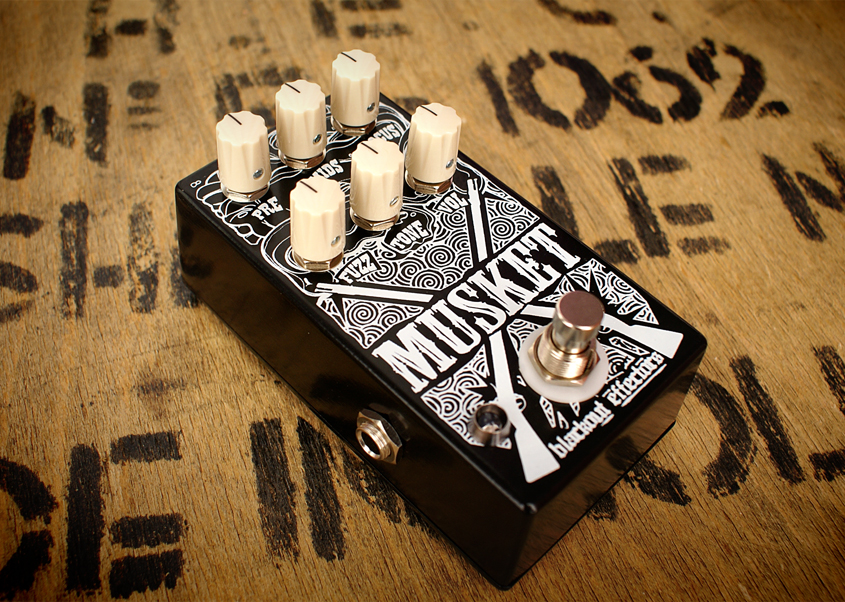
Blackout Effectors Musket v.1

Blackout Effectors is an effects pedal company that recently relocated from Canada to Asheville, NC.  Their pedals are unique takes on overdrive, fuzz and phasers that are "Handmade with Precision and Balls."  This is another company that I just totally lust after.  All of their pedals just get into my veins and I get swept away (why don't I have enough cash?!?).  The Musket is the first pedal that I have had the pleasure of playing through and hopefully not the last (::cough:: Whetstone ::cough::).  This pedal is well loved over on Talkbass.com and for good reason.

From Blackout Effectors:
The logical progression from then to now, the MUSKET is based 
on one of the raunchiest, best selling fuzz circuits of all time
-taken three giant muffy steps further.  With the addition of the
PRE, FOCUS, & MIDS controls, the MUSKET is able to traverse
the decades,, the continents and the many iterations of the
classic 4-stage fuzz circuit - from emulation to beyond.  If you
need fuzz and need it to be massive…..

And bass players, look no further.  The Musket brings the 
thunder to perfectly compliment your lightning.  You'll 
find the Musket on pro bass player boards
the world over.


CONSTRUCTION:

"Handmade with Precision and Balls" pretty much sums up this pedal's construction.  Solid circuit design and discrete soldering points (definite care in construction).  The knobs are sturdy and turn  smoothly.  Foot switch: good to go.

GRAPHICS: 

There have been many different graphic versions of this pedal over time, and they kind of give a history of the evolution of the pedal, circuit design and of Blackout Effectors as a company.   The original graphic design was the "Red Rifles" edition, which was an homage to the builder's grandfather if I am not mistaken.  The current version of the Musket (version 2 as far as the circuitry goes, but the third or fourth version graphically), is similar to the "Red Rifles" design, but it is all black and white.  My Musket was the first version of the circuit with the mountain of tone graphics (which incidentally is my favorite one they have released as of yet).  I think that the second version of the circuit is one that incorporates a greater degree of control through each knob (especially the MIDS and FOCUS knobs, which we will get to in a minute).  

Also, something that I think is a really cool touch about the style of this company is that on the inside of the pedal cover, they paint an artistic representation of the number of the pedal (mine was #157, I believe).  Sometimes this is just the number painted in a cool way and sometimes there is a kaleidoscope of awesome in there.  It just depends on who was working the day the pedal was finished and how creative they were feeling (the custom Storm Trooper is definitely up there on my favorites-list).  A really cool touch in my opinion.  It's really little touches like this that make independent builders stand out from the crowd.

TONE:

Here is the "balls" part.  BEEF.   For a muff based circuit, this pedal has an incredible range of tone. The bottom three controls are the traditional muff controls of Fuzz (saturation), Tone and Volume.  Pretty much standard issue as far as sound goes.  The top three controls are what really make this muff circuit stand out.  The PRE control knob acts like a pre-gain boost stage in front of the circuit (sort of) that lets you have greater control over the range of the FUZZ knob.  At a minimum PRE setting, the overall saturation of the fuzz circuit is pretty tame.  When the PRE and FUZZ knobs are both maxed - STAND BACK!!!!  Now you have a fuzz pedal that has complete control over the saturation sweep and you don't have to always set it on the maximum saturation setting to get a usable tone like you do with older muff circuits.  
The MIDS knob works really well with the TONE knob to shape the character of the pedal.  While the TONE knob is a sort of traditional muff-based mids sweep (counter-clockwise being really scooped, traditional muff tone), the MIDS knob will boost or cut the middle frequencies in pleasant new ways.  This is the main feature on this pedal to help keep the bass from getting lost in the mix.  Cranking the MIDS knob will give you an in-your-face snarl that demands your attention.

The FOCUS knob is an interesting and welcomed touch to this circuit.  This knob will take you from articulate crunch (clockwise) to sloppy low end awesome (you guessed it counter-clockwise).  For bass players, the focus knob really needs to be set in the left side of the knob's range (the sloppy side).  Not specifically because great gobs of sloppy molasses fuzz is awesome, but because as you get progressively further clockwise on this knob, the low end starts to disappear almost into lo-fi territories (for a bass).  Killer.  

I felt that this pedal's primary sound scape isn't necessarily focused on the DOOM side of things, however.  What I mean is that it wouldn't be my first choice for the heavy DOOM breakdown of a song (a la hammering down on the low B) or the slow drone of a stoner / doom metal type of band.  This pedal has a snarl and a bite to it that I think is better suited for quick riffing and that "Every Time I DIe" in your face kind of bass tone, which it excels at.  Different strokes.  

Killer.

Also, the Musket is also available in a dual pedal format with another of Blackout Effector's killer fuzzes the Fix'd Fuzz called the Twosome Fuzz.


Please go checkout the awesome clips and videos over at Blackout's webiste:


NOW.


Monday, April 4, 2011

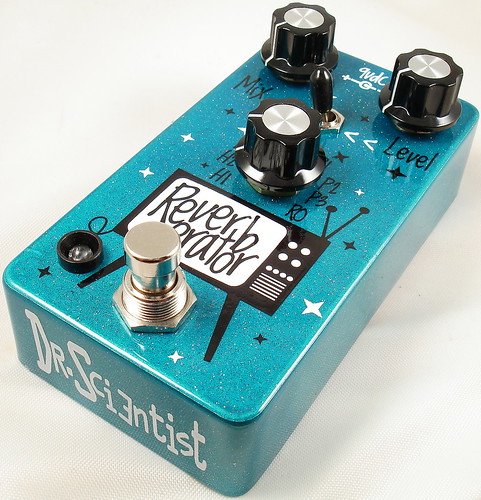
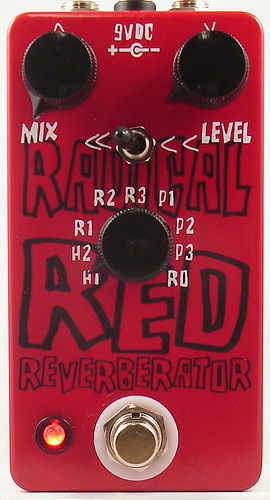
Dr. Scientist Radical Red (mini) Reverberator

Here ya go folks, the Dr. Scientist Radical Red (mini) Reverberator!
Dr. Scientist is one cooky, crazy effects company from our friends in the North.  Canada, Eh? (I’m sorry I had to.)  This is another company that puts out some seriously boutique pedals (with prices to match) and a super fun company visual presence.  I’ve heard a few different pedals from this company live (usually on guitar) and they have always sounded great (especially the Sunny Day Delay).  My attention was drawn to the Radical Red Reverberator while I was on my quest to find a killer sounding reverb that took up less space than my Boss RV-3 (always an issue).  I think that it suits that role nicely.
Full description and mp3 samples are available on Dr. Scientist’s website:


CONSTRUCTION:
One word: boutique.  This pedal is pretty synonymous with this term.  High quality build materials, layout true bypass switching and and sturdy enclosures.  These pedals were originally in a different sized enclosure, closer to the sized aluminum enclosure that Electro-Harmonix uses on their XO series pedals.  Luckily for all of us, Dr. Scientist figured out a way to cram all of that reverb-y goodness into an MXR micro sized enclosure with the in and out jacks on the top of the pedal (along with the power jack, which is “Boss” style tip negative).  All of this added together makes for one ridiculously small pedal. The reverberator will not run off of batteries (yay earth!) and does NOT like to be daisy chained, although an isolated power supply such as the VooDoo Labs Pedal Power 2+ will work just fine.
Of course, when you start talking ridiculously small pedal enclosures, you also have to include small spaces.  What I mean is that one thing that I have noticed with this pedal is that you have to be careful (or at least aware) of the direction and position of the in and out jacks with the power jack also being right next to them.  If you are using right-angled 1/4” cables that are coming in from the side (diagonally or whatever) things can get really tight.  Not really an issue considering how much space the mini- reverberator takes up, but I just thought I’d bring it up.


GRAPHICS:
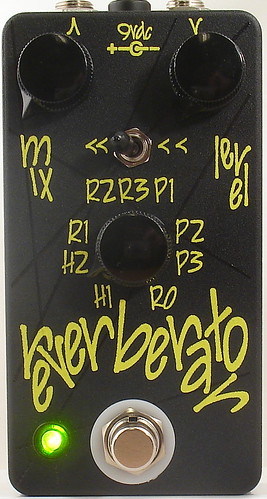
If I’m not mistaken, these pedals are hand painted by one Mrs. Dr. Scientist and she does a terrific job with them!  They come in a variety of different themes, mine is the black and yellow one shown, but there are many others.  The blood one was a close second choice.  Mrs. Dr. Scientist has also been known to do custom graphics from time to time.  My favorite so far being the CosmiChorus with a Kirby theme.  I’m not sure if that costs extra though...just ask Dr. Scientist!  I didn’t want to wait for mine to get here, so I ordered mine from either tonefactor.com or analoguehaven.com, I can’t remember which one right now, but both stores are killer.  I’m sure if you contacted Dr. Scientist directly, a graphic change wouldn’t be a problem.
TONE:
Lush.  The controls are pretty straight forward with a Mix knob (a wet/dry blend) a volume knob (with up to 20dB of boost) a Slow/Fast rate switch and a nine position rotary switch.  The volume knob is so awesome that I wonder why more reverb/delay units do not have them.  Having a master volume control helps bring everything up in the mix (definitely needed with reverb) and lets you be heard (definitely needed in my band.......what was that?!? You’ll have to speak up! I CAN’T HEAR YOOOUUUU!!!).
The Reverberator hosts two Hall reverbs, three Room reverbs, three Plate reverbs and a Rotary (Leslie Speaker) emulator setting (neat).  All of the different settings on the rotary knob are conveniently labeled by a letter an number (H1 for the first Hall setting, nice, huh?).   Also, a neat side-effect of the design of this pedal is that when the pedal is on, and you change the rate of decay there is a “swoosh” or like a little burst of reverb that is perfectly normal, and totally awesome.  No, your pedal isn’t broken.... “this means it is please with you and can be considered a blessing from the Gods of Reverb, watching from upon high. (They are in your house and they are watching you.)”
My favorite settings for bass are the second Hall reverb with the rate switch in the “slow” or long decay position and the third Room reverb with the switch in the fast / shorter decay setting.  I like to use them for big reverb filled volume swells with lots of chords and/or fuzz.  The rotary speaker emulator is also really neat sounding.  I almost wish this was a stereo pedal so that I could hear the rotary ping pong back and forth....but I guess that would defeat the purpose of getting the smallest reverb pedal I could find.
One really cool thing about this pedal is when you set the mix knob to completely dry it acts as a totally clean boost.  Awesome. KloBber YouR TuBEZ!

Be sure to check out the Radical Red (mini) Reverberator as well as all of the other Dr. Scientist pedals on their website:

Tuesday, March 29, 2011

INTERVIEW with Ryan from FUZZROCIOUS


Right, so this was an interview that my ladyfriend Margo did for her blog (http://www.margopage.com) for her regular Indie Artist Spotlight column.  Here it is:


Fuzzrocious is a fantastic duo of husband and wife team, Ryan and Shannon Ratajski. They are fabulous people who build fabulous bass/guitar pedals. How do I know this? Well, sadly I am not the rock star some may think I could be. I don’t even play a string instrument. I herd about this two through Colin. He is always receiving packages in the mail, mostly bass pedals and gear. I often sit an watch him open these packages because he seems like a child opening birthday presents, it’s very exciting. I watched him open a box the other month and this super cool pedal came out it was hand painted!!!! and had the coolest name! No, surprise it was from fuzzrocious and by the way they sound as good as they look!!!! With out further ado….
1. What is your name, where are you from and what do you do?
Who is your daddy and what does he do?……Ryan and Shannon Ratajski (Ruh-tie-skee) here from Fuzzrocious Pedals! We’re from Mount Laurel, NJ and we build guitar/bass pedals for wild musicians who like to play loud and dirty. I (Ryan) build the pedals and Shannon hand paints each one.
2. Tell us a little more about yourself?
Fuzzrocious is not our main job, although it would be amazing if we made enough money for it to be…We both work in Early Childhood Education (preschool) full time. Besides work, our time is eaten up by our two monsters. Our lives revolve around our children, work, and pedals. Shannon is in her last semester of Grad School and I am ¼ of the way through my Master’s Degree…We’re a liiiiiittle busy!
I play bass in a band called, “CAVALE”.
3. How did you acquire your craft/art? 
My buddy and old band mate Lukas Judge McCutcheon got me into building guitar pedal kits from General Guitar Gadgets. He had these plain boxes on his pedalboard that did all kinds of wicked stuff. People always told me that I would LOVE a big muff, so I asked me dad to teach me to solder! We sat down and after a few beers and hours, I had my own GGG-tuned BMP clone! From here, what Brian at smallsound/bigsound calls “the black hole” began…I contacted every friend in music I knew and started building them pedals! A year and half later, I started working on stripboard and taking existing designs and adapting/modding them further to do what I wanted them to do to become the beasts that we make today!
Shannon’s grandmother painted as a hobby and taught her how to paint as a child. This grew into a passion for her through high school and led her to The University of the Arts to obtain a Bachelor’s Degree in Fine Arts (Painting). She meticulously paints each pedal by hand.
4. What inspires you?
My first foray into effects was a Boss DD-3 delay pedal. I used to scream in a band called, “TWO DAYS…” and I loved how the singers in bands like Deftones and VOD used delay effects on their vocals, so I tried it for a hot minute too.
When I started playing bass, my bandmates (James Gross and Lukas) were my first inspirations in playing pedals for real. Once I learned about pedals, I couldn’t stop listening to music without listening to the effects that were being used…annoying…
Bands like Failure Cave In, Deftones, Botch, Coalesce, Minus The Bear, fordirelifesake, Third Eye Blind, RATM, etc. made me appreciate and fall in love with effects totally, especially the dirtier effects.
5. What is your creative process?
I don’t want to put this in writing haha.
6. What do you find to be the secret to your success?
On a personal level, Shan and I find it gratifying to have people love something that we had a hand in making just for them. We have some pretty amazing customers that I chat with on the regular who make building pedals worth doing!
When we get to work with dudes in bigger bands, it’s a dream. I love music, period. Being able to build real friendships with dudes I respect from bands is worth every hour I spend breathing in harmful soldering fumes. 95% of the band dudes we’ve worked with are down-to-Earth, normal dudes who love pedals. I reach out to dudes who I think will be similar to me and my interests. I’d rather shoot the **** for a few hours with someone I can have a conversation with than some doucher who only cares about free pedals or doesn’t care about hanging out with real people.
Because we are so small, we get to be selective!
Monetarily, I wouldn’t say that we’re a success yet, since we’re not making much money at all from this.
Also, Talkbass' effects community is literally supporting us in total. We don’t have to advertise anywhere else at this point because they keep us so busy. I am eternally grateful for this forum and the people who are on it!
7. Where are you now in your creative business and where will you be in the future?
Our customers always want to pay us up front. The reason that we don’t take money until production starts on a pedal is that we don’t know what the future holds! Health, school, family, etc. could cause the end of Fuzzrocious in a heartbeat. We are pluggin’ along right now. I’d like to be moving faster with production, but our day-to-day just doesn’t allow that.
In the near future, I’d like to move faster with production. At this time, I can only see Shan and I doing this as a two person team.
8. Any words of wisdom to share with fellow artist/crafters?
Check your email, respond to messages within 24 hours, give people concise answers, and be honest.
9. What is your most favorite handmade item you have had to part with?
Nothing yet! I don’t make any hardcore attachments to our pedals like that. If I want something, I can just build another!
10. Why do you love doing what you do (what fuels the fire)?
I like making things that make lots of noise. More than that, I like having people like what we make. Being able to have people go ape**** over a pedal that you made for them is totally gratifying.
11. Shameless advertising, go for it babe? We want all your info!
http://www.fuzzrociouspedals.com
http://cavale.bandcamp.com

Thursday, March 24, 2011

Electro-Harmonix Bass Big Muff Pi XO


Wow.  My first fuzz pedal (my first pedal ever, actually, if truth be told).  I figured when I was deciding (and boy did I contemplate this for a while, as I always do) on my first fuzz pedal that I should start with the “standard” and really get to familiarize my self with what the original muff sound was all about before I could really appreciate more extravagant fuzz pedals.  Whether or not that worked is subject for some debate, but at least I had good intentions, right?
Electro-Harmonix pedals are something of a standard in the effects world (just like BOSS/Roland or any of the other “biggies”).  Although some of their effects releases of the past, namely during the nineties were not the greatest (what was with those cheap aluminum enclosures, I ask you?!), they always sounded killer and were known for their innovative approach.  I think that their muff circuit (aptly named the Big Muff) was the first fuzz pedal that was produced and a later version, the Russian Green Muff (also known as the Sovtek Green Muff, or the “Civil War” Muff) is what this current production model is based on.  
CONSTRUCTION:
Thank (or insert your favorite deity here) that EHX decided to revamp their product line with the new XO series pedals.  The build quality and the quality of the enclosures are NIGHT AND DAY better / sturdier than the big, bulky aluminum enclosures of their early pedals.  The circuit boards are properly mounted and the construction quality is much higher overall. 
FEATURES / TONE:
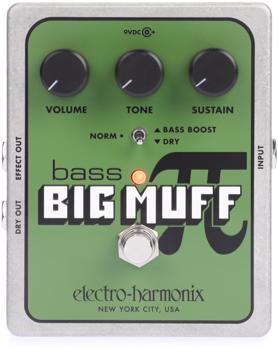
The proprietary Muff controls of Volume, Tone and Sustain are here in full force with the addition of a three position mini switch with Dry, Normal and Bass Boost modes (more on that later).  This circuit also features not only an effected “wet” output but also a “dry” output for blending your clean and effected signals at a later point in the signal chain, or running into two separate amps, one effected and one dry.
The big three controls on this pedal are standard for pretty much all muffs and their various clones with the Tone knob controlling a sweep in the mids going from muffled to bright (for a muff).  The Bass Big Muff Pi is definitely not the most versatile pedal ever made.  It designed to be a wham-bam-thank-you-m’am type of pedal.  The three position helps expand the versatility of this pedal somewhat, but it is still a simple pedal at the end of the day.
The three position switch with Dry, Normal, and Bass Boost modes don’t offer the most variety ever, but they are effective at what they do.  The Bass Boost mode is really useful for bringing the hammer down on the mix and filling the low end out to make up for the “where’d my bass go?” syndrome that seems to plague most muff circuits (do to the sweep/scooping of the mids).  I liked leaving the pedal in the boost mode the best because I had it set for DOOM and it really felt like another cabinet was added to the mix when this pedal was on.  Honestly, there have only been a few pedals that really kicked me in the chest like the bass boost mode did on this pedal, however the scooped mids inherent to the muff’s design still cause some of the “disappearance effect,” but that is something you always run into with standard muff circuits.  
The “dry” mode is improperly labeled in my opinion because the dry output on the pedal is also labeled as such and that can be quite confusing before you get your mind wrapped around this pedal.  The three position switch has zero effect on the dry output of the pedal, which is always present if the dry output is being used.  The “dry” position on the three position switch is EHX’s version of a built in blend, mixing the fuzzy tone with your clean signal.  
The shortcoming of this setting is that you have no control over the ratio of wet to dry ratio like you do on other pedals.  Even though the volume knob is supposed to affect the way the wet and dry signals intermingle.....it isn’t that apparent...or useful.  
Overall this pedal is a great introduction to muff-type pedals, and fuzz pedals in general for that matter and I am glad that it was my  first pedal.  It was very  helpful as a starting point into the wide world of fuzz pedals and muff clones and I recommend if not for that purpose alone.
  Great for the price point, and you can pick them up on the used marked for dirt cheap if you look around ($45-65).  


www.ehx.com

Friday, March 18, 2011

Wounded Paw FX: Battering Ram

Ah the mighty Battering Ram from Wounded Paw FX.

Wounded Paw FX is an effects pedal company based (see what I did there?) out of Toronto, Canada.  They make a couple of different products, some of which are specifically geared towards the bass guitar (see: Attack Goat, Bass Fuzz) and most of there other pedals at least work well with the bass.  They also make several non-effects pedals that are highly useful, such as four channel mixers and routers, blend and mute pedals and expression pedals.  Super cool company and my experience with them was smooth.  Although, since this company is based out of Canada, you will have to deal with a longer than average wait time if you are ordering from America when the pedal is crossing the border, because it will probably get stopped at customs.  Just be ready for that. 


From Wounded Paw:

The Battering Ram is an Overdrive plus Fuzz pedal which works equally well for guitar or bass or anything else you want to plug into it.
Stomp on the OVERDRIVE switch and you turn the pedal on and activate the Overdrive section. It's a smooth overdrive which can go from completely clean to growling distortion via the DRIVE knob.
The LO switch adds in the lower frequencies to make it full-range for bass or other instruments.
The HI knob lets you either boost or cut the highs to dial in the tone you want.
The LEVEL knob on the Overdrive side controls the output volume of the Overdrive section only.
Overdrive plus Fuzz means that while the overdrive is on all the time, the fuzz can be added on top of the overdrive, without affecting the overdrive's volume or tone. This is a parallel processed pedal which means the fuzz section works from the clean input signal and gets mixed with the overdrive instead of one section following the other like in 2 stage pedals.
The FUZZ section is switched on via a second stomp switch and has it's own LEVEL knob to control the Fuzz volume separately from the Overdrive. The fuzz sound is snarling and raspy and can get right out of control if you crank up the SUSTAIN. The deep lows are filtered out to keep it tight and bright.
The TONE control goes from high-end cut to flat to a mid-cut, high end boost.
And for another set of sounds there is the OCT switch to change the fuzz section into an octave up fuzz. Crazy.
This pedal can be used in a number of ways. Have the overdrive on all the time for your basic tone and stomp on the fuzz for that important bridge, chorus or solo. Or use both sections to shape your total distortion sound. Use the overdrive for the lower frequencies to keep the growl without getting muddy and use the fuzz for the searing top end. Or keep the overdrive section tame and use the fuzz section with the octave switch on to add that one bit of octave up.

Heavy Duty 4.7" x 3.7" Aluminum Enclosure
True Bypass
Bright Blue and Red LEDs


CONSTRUCTION:

Superb.  This thing is build like a tank.  Strong true-bypass switches, sturdy knobs and stitches, quality metal jacks.  

GRAPHICS:

The enclosure is professionally silk-screened and has a textured feel to it.  Definitely sturdy and won't chip or scratch easily.

TONE:

As stated above in the message from Wounded Paw, this pedal is more like two pedals in one box, rather than one big circuit, if that makes sense.  There is the overdrive side, and there is the fuzz side.  The  left foot switch, which is labeled "overdrive" should probably be labeled "bypass" instead because that is what turns the pedal on and off completely.  This switch engages the left most three controls (Drive, Level and Hi) as well as the "Lo" switch.  The low switch is a must for bass players in my opinion, but you can get some sweet Chris Squire-Rickenbacker snarl from this pedal when the low switch is not engaged.  The Level knob is self-explanatory and there is a ton of volume on tap.  I got some great drive tones out of this pedal even though I felt that the low-gain-just-a-bit-of-break-up thing was not it's forte.  This has some snarl and it likes it that way.

Then there is the fuzz "side" of the pedal which is engaged with the right foot switch labeled "fuzz." Convenient, huh?  It is important to note that this switch cascades the overdrive section of the pedal into the fuzz side of the pedal and that the controls on the left side of the pedal effect the fuzz tone as well.  Think of it more like having a separate overdrive and fuzz pedal one after another on a pedal board except that they are hooked together.  The fuzz controls are the right most three (Level, Sustain, and Tone) and the "Oct" switch which engages a subtle octave up signal into the mix.  I love the fuzz in this circuit.  Awesome.  

Here's the rub, and the main reason that this pedal (though fantastic) is not on my board at this moment.  Overdrive side: killer.  Fuzz side: killer.  Finding a tone that suits both: problem city.  I love the overdrive side of this pedal, and I love the fuzz side too, but the problem is that if I got the settings on the overdrive side to where I wanted them, I felt like I had to compromise the settings on the fuzz side.  Or if I set up the fuzz just the way I wanted, the overdrive wasn't really what I wanted either (since the overdrive is cascaded into the fuzz tone).  I know that this is inherent in the construction and design of the pedal, but if there was any way to release a deluxe version of this pedal where there was an overdrive side and a six knobbed version of the fuzz on the other side, I would buy it again, no questions asked.

Then again….maybe I just didn't think to use this in all the ways it could have been used.  Like having the overdrive side on all the time as is described in that bit from Wounded Paw above, and just kicking in the fuzz side for the heavier bits…even if it is not as beefy as a Muff or whatever, it may still just be used as a really gnarly overdrive.  Hrumph.  I may have to find one of these used now and try it out again.  And I thought these reviews were supposed to help my gear addiction!!

Check out Grygrx's review over on Bassfuzz.com for clips and video.


Wednesday, March 16, 2011

Boss RV-3 Reverb/Delay Pedal


I had this pedal for quite a while and loved every minute of it.  I’ve had a fair few Boss pedals during my tenure and they have always impressed me for their price point to sound quality ratio (although some of their effects are dramatically better than others).  Although this pedal is discontinued, you can usually find them on the used market for around $140 if they are in good condition.  I’ve heard of people getting lucky and finding them for much lower than that though.
FEATURES:
This pedal has four knobs, a wet/drive knob labeled BALANCE, a TONE knob that also acts as a feedback knob depending on the setting, a Reverb/Delay time knob and an 11-position rotary switch to change the reverb or delay setting that the pedal is producing.  The rotary knob breaks down like this:
01> DELAY (32-125ms)
02> DELAY (125-500ms)
03> DELAY (500-2000ms)
04> DELAY & REVERB (ROOM 1) |
05> DELAY & REVERB (ROOM 2) |--All with 32 - 1000ms of Delay time
06> DELAY & REVERB (HALL) |
07> DELAY & REVERB (PLATE) |
08> REVERB (ROOM 1)
09> REVERB (ROOM 2)
10> REVERB (HALL)
11> REVERB (PLATE)
This is really neat because you essentially get two pedals in one.  
CONSTRUCTION:  
It is made by BOSS and their name has pretty much become synonymous with “tough.”  In fact the reason most people (including professionals mind you) love BOSS is their unwavering reliability.  Over the years, they have become the standard by which all other pedals come to be judged (at least construction wise).
TONE:
At first the delays on this pedal didn’t really knock my socks off.  Pretty much standard boiler plate, I guess.  Maybe it was because the delay was digital (which can be a hard barrier to overcome for most tone purists), or because I bought this pedal specifically for use as a reverb, but I never really used the delays on this pedal.  I think the biggest stumbling block in that sense was that I pretty much have to have tap-tempo for my delays....I just do.  I wish I didn’t, as there are a lot of really cool delays that I want to try (namely the Malekko 616 and Echo600 Dark).

I mainly used this reverb on the HALL setting (rotary number 10) with the reverb time just past noon (closer to one o’clock) and the feedback knob around eleven o’clock.  This setting is lush, full and big.  I used it with my volume pedal for chordal swells and general epic-ness.  This setting isn't necessarily good for that quick spring reverb sound that is almost like a slap-back tone, but honestly, who cares? EPIC = WIN.
I've heard that a lot of guitar and bass players prefer this pedal to the newer RV-5.  I haven't had both of these pedals at the same to compare them to each other, but I definitely love how lush and full sounding the reverbs were on the RV-3.  I guess one of the structural improvements of the RV-5 is that it has stereo inputs and stereo outputs, while the RV-3 only has stereo outputs.

This pedal sounds rad.  I really liked the fact that this pedal has a wet / dry blend knob and that you can really dial the amount of un-effected signal.  One thing that I wish would be on more reverbs and delays is not just a blend knob, but also a level knob, so that you can boost the overall signal.  That would be nice.  Sometimes it seems that signal just disappears.  The only reason I sold this pedal was because my board real-estate is always at a premium and it took up a little too much space for me to be comfortable with. Great sounding reverb though, I would own another one in a heart beat.